Storytelling Guide: Dan Harmon’s Story Circle Explained
A full practical guide to the 8-step Story Circle, from comfort zone to character transformation.

A Universal Language of Story
There are two universal languages: mathematics and story. Storytelling is part of human experience. We pass on history through stories, learn how to live, and test ideas of right and wrong.
You do not need a literature PhD to recognize whether a story works. Most audiences can feel when a story structure is clear, and when it collapses.
What Is Dan Harmon’s Story Circle?
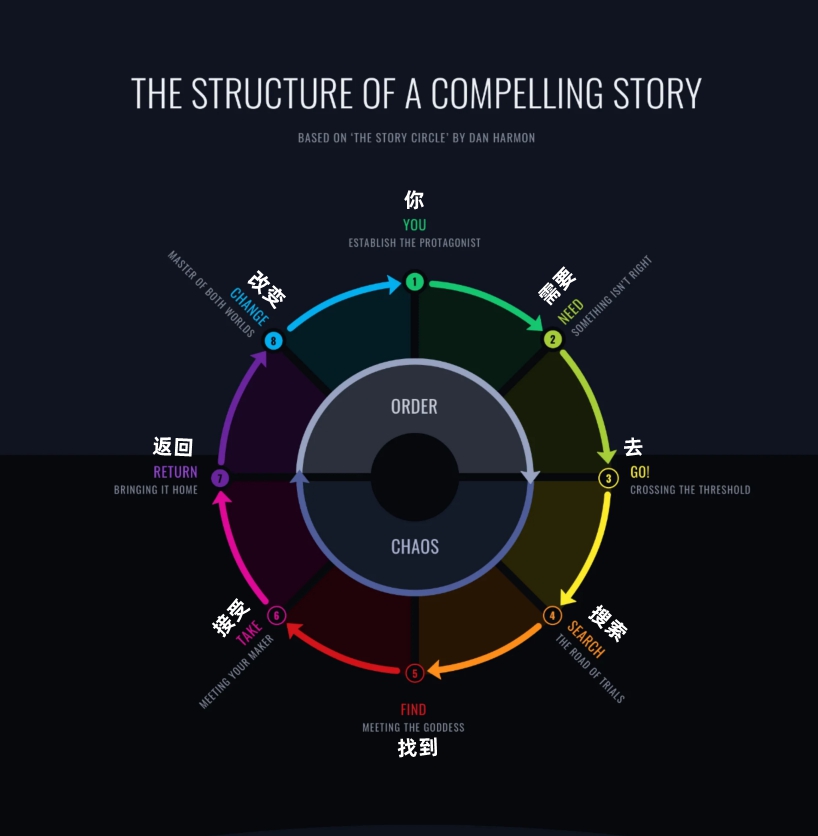
Dan Harmon’s Story Circle is an eight-step narrative framework that tracks a protagonist leaving a comfort zone, pursuing a need, paying a cost, and returning changed.
The eight steps are:
- You — the character is in a comfort zone
- Need — they want something
- Go — they enter an unfamiliar situation
- Search — they adapt and struggle
- Find — they get what they wanted
- Take — they pay a heavy price
- Return — they come back to the familiar world
- Change — they are transformed
The circular shape matters: heroes descend into difficulty and rise back up with consequences and growth.
Step 1: You
Establish the protagonist and normal world. The protagonist can be an individual, a family, or a team. The key is to define the baseline state before change.
Step 2: Need
An inciting event creates a gap or desire. The story moves from “who this person is” to “what this person must pursue.”
Step 3: Go
The character takes action and crosses into the unknown. Without this step, the story stays in setup mode.
Step 4: Search
The protagonist encounters friction, tests strategies, and learns new rules. Narrative pressure is built here.
Step 5: Find
They achieve a short-term objective, but usually not the deeper need. Great stories raise the emotional and moral stakes at this point.
Step 6: Take
Every gain has a cost. The cost can be relational, ethical, physical, or psychological. This is where stories become meaningful.
Step 7: Return
The character brings something back: skill, truth, relationship, or responsibility.
Step 8: Change
Change closes the loop. The world may change, the character may change, or both. Without visible transformation, the arc often feels incomplete.
Closing Note
The Story Circle works because it makes character transformation executable. It can be used in writing to design arcs, and in editing to test whether each sequence advances the protagonist’s change.