Danse Macabre puts a face on the destruction just before the title
Armies move as one at the start. One eye is enough to stop that spectacle from being easy to watch.
The complete director-uploaded trailer, approximately 00:00–01:00.
Hisko Hulsing’s Danse Macabre trailer keeps assembling armies, aircraft and crowds until it can replace all of that movement with the opening of one eye. The contrast makes the eye feel less like the introduction of a protagonist than a demand to take a second look at what the trailer has let us enjoy.
The opening makes the machine easy to watch
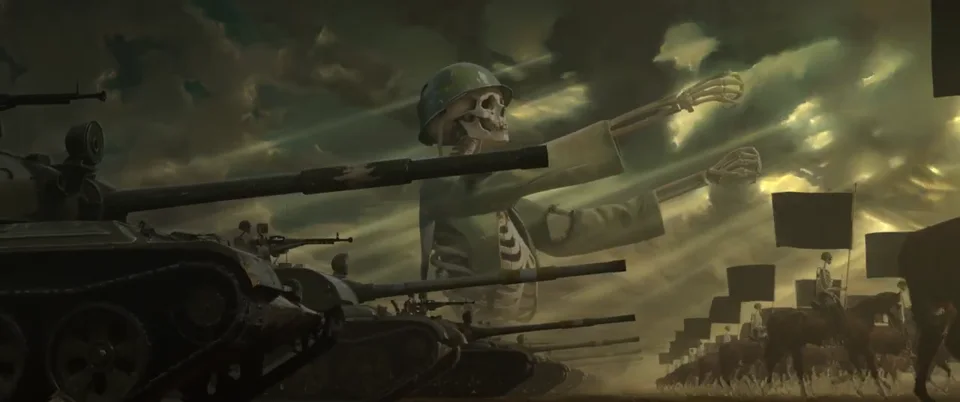
At about 00:02, tank barrels cross the foreground and a huge skeleton behind them extends its arms in almost the same direction. Seen together, the long straight lines briefly make troops and machines feel like one coordinated body. It’s a striking composition, and a disquieting one. The skeleton gives the formation personality while the people in its path are still small enough to lose in the frame.
The same gesture turns against the formation
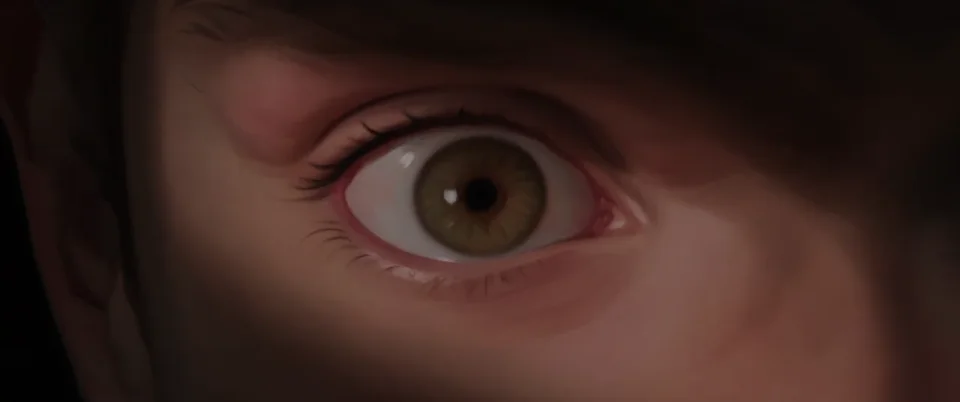
Around 00:30–00:34, arms rise in front of an orange fire. The shape rhymes with those forward-thrust arms at the start, but these hands are scattered across the frame and have no common direction. The first gesture makes the group look capable of acting together. The second makes you aware of what a single body can’t do. Then the trailer shows a man with his mouth open and a woman with both hands to her face. An eye between flashes of black displaces the whole battlefield.
It leaves the eye without an answer
The soundtrack still has weight when the scale changes, though it thins under the run of black and eye images. The trailer’s credit connects the film to Shostakovich’s Tenth Symphony. The quietest part of that transition gives the eye room to hold our attention. The eye could be part of a straightforward awakening. The trailer leaves too little context to decide whose eye it is or what the person has seen. That uncertainty is more interesting than an explanation would be, because the sense of looking is the one thing the close-up makes certain.
Related story cards
Horror · 24s
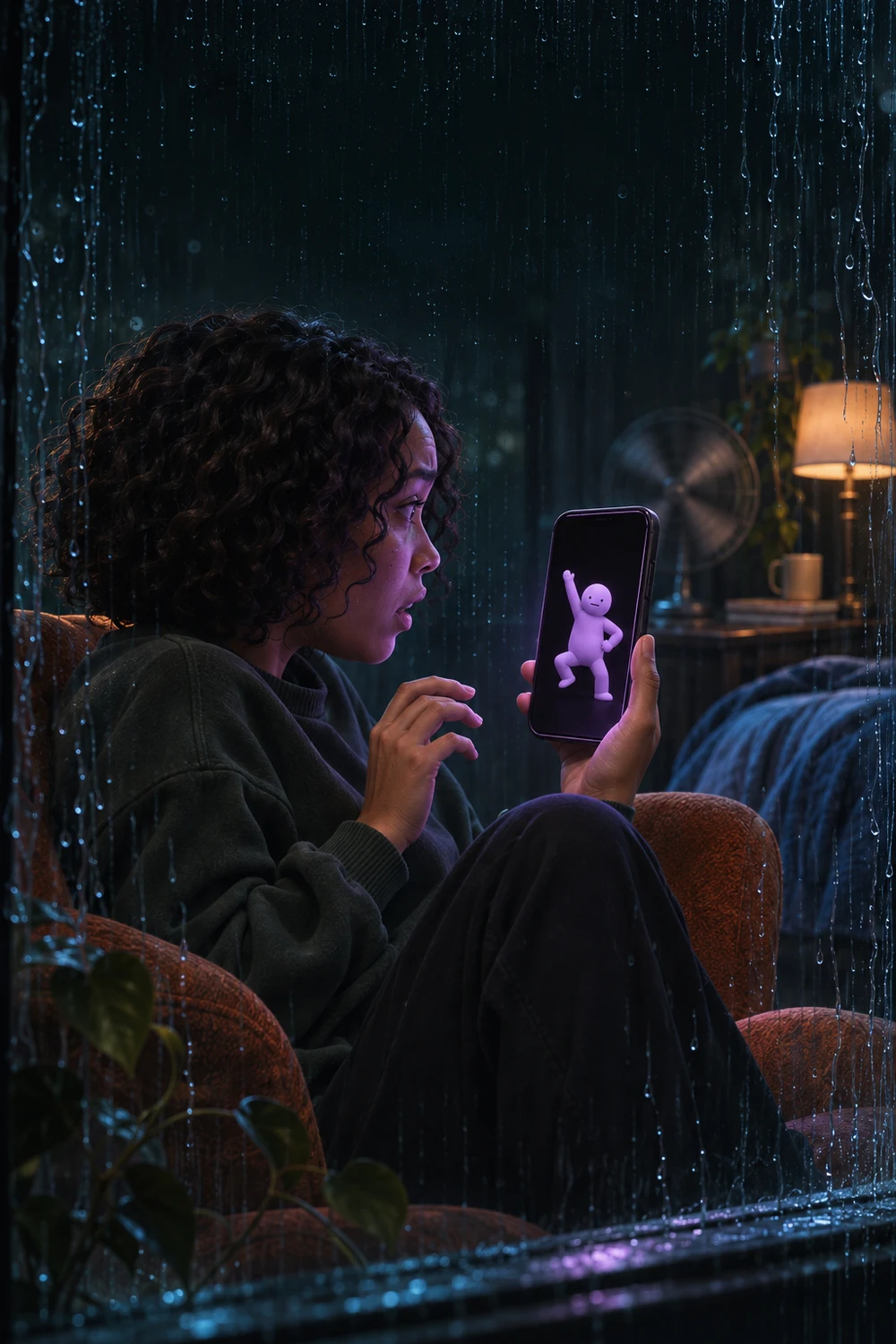
After You Press Pause
See how a change in sound and framing can turn somebody looking at a screen into the subject of the scene.
Read the full script →
Action · 22s
A Hand in the Haze
After steam hides an entire room, a hand reorients the scene around one person’s immediate experience.
Read the full script →