Why is one copy of the Dickson Experimental Sound Film silent?
Watch the dancers once in silence, then with the restored violin. The horn taking up half the room starts to look worth the trouble.
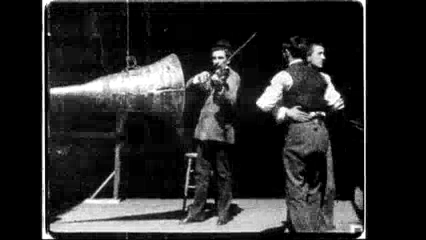
The first presentation of the surviving dance in the Internet Archive restoration, about 01:05–01:22, and the Library of Congress silent edition.
Look at the left side of the frame. A flared horn points straight at the violinist. The two dancers have to share the strip of floor on his other side. In the Library of Congress upload, you can follow their turn perfectly well in silence. What’s harder to understand is why the man playing for them gets so little room.
One performance left two objects
The moving pictures were recorded on film. The violin went onto a separate wax cylinder. The Library had already preserved the picture on 35 mm when it obtained a transfer of the recording. In 1998, at a conference in Washington, someone tried playing that transfer on a boom box while the film ran repeatedly. Mike Mashon, who was there, remembers how poorly the two lined up. Starting two machines together still left a question. Which note belonged to which bit of film?
The horn takes its share of the floor
In the restored presentation, go to about 01:09. A thin, rough-edged melody accompanies the turn. The player stays close to the mouth of the horn while the two dancers circle each other. By 01:21, even a fourth figure can slip into the edge of the shot. Try covering the dancers for a moment. What remains looks like a man at work, holding his position so the apparatus can hear him. Uncover the right side and the same tune becomes something two people can dance to.
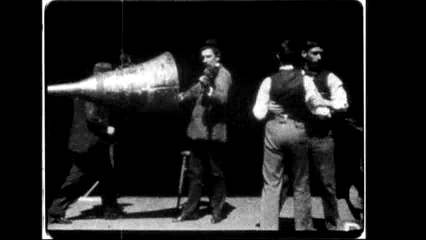
What the editor could match
Walter Murch describes receiving about seventeen seconds of picture and a much longer recording. Sean Cullen converted the picture for video. Murch looked for possible points of agreement and adjusted the length of the sound. It’s tempting to pick a turn of the bow and declare it proof that the machines were locked together. The bow is hard to follow against the player’s clothes, and a convincing musical phrase can make several movements feel right. The restoration lets us hear the performance together. How the original equipment kept time remains an open question in Murch’s account.

