How handwriting tells a life in Don Hertzfeldt’s Paper Trail
A life told through freehand marks, answer sheets and a signature.
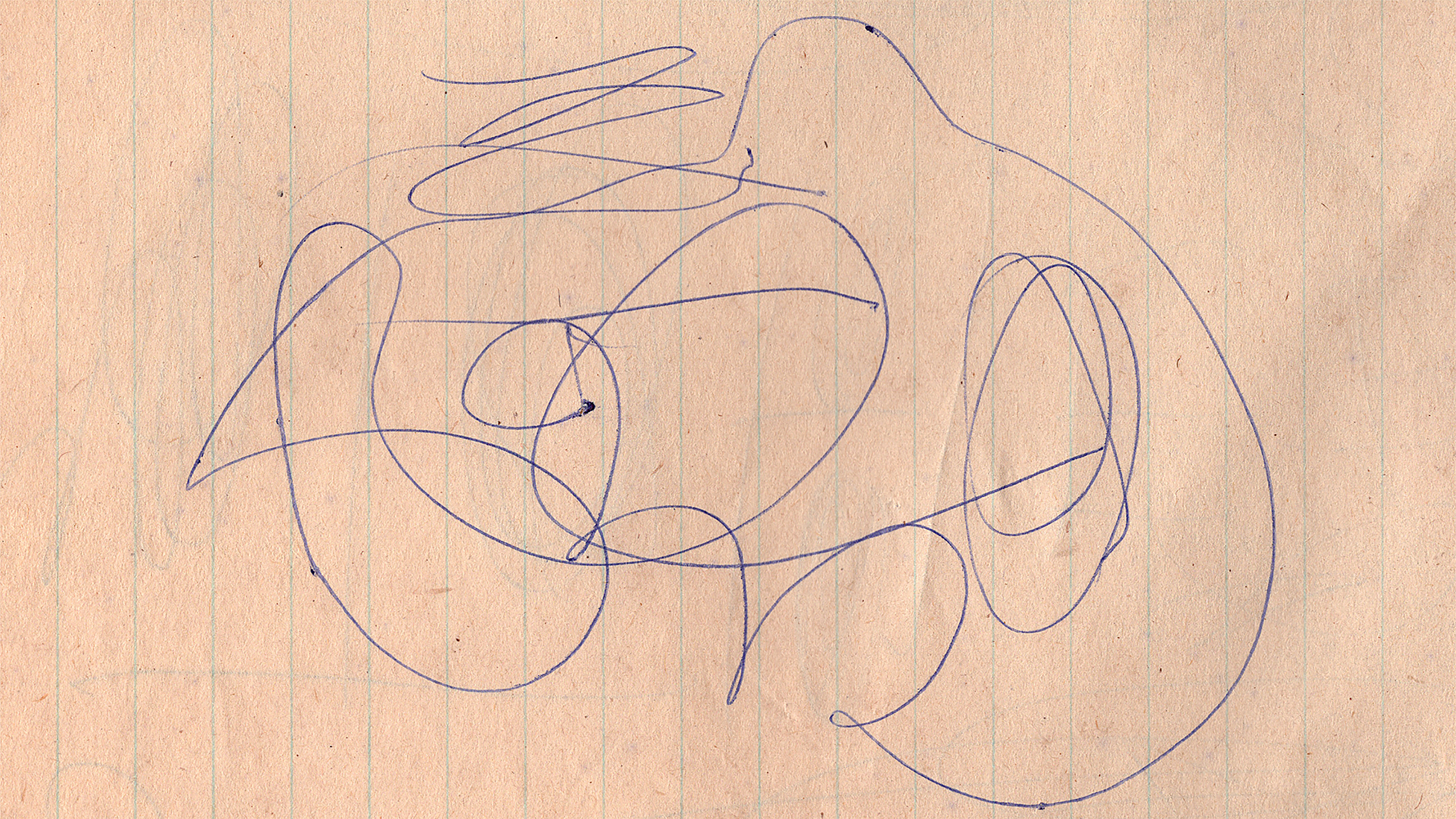
This visual commentary examines six selected frames from the filmmaker’s Vimeo release.
At 00:51 in Paper Trail, an uneven green stroke crosses a white page. At 07:20, orange rows of numbered answer bubbles fill the frame. At 09:20, Steven Richardson’s blue signature sits on a form beside the word “Clerk” and a red approval stamp. These three images suggest a way into Don Hertzfeldt’s animated short. The shape of a mark tells us something about who gets to decide what belongs on the page.
The space around a mark changes
At 00:12, a small blue mark takes up only a fraction of the white frame. At 00:22, several green marks are separated by wide gaps. By 00:51, the colored line stretches across the picture, with a second green mark running underneath. Up close, its rough edge is still visible. The blank space draws the eye toward small differences in pressure and shape, the kinds of details we usually glance past on a sheet of paper.
The ruled page at 05:30 offers a useful intermediate image. A cursive stroke rises and turns within a band of printed guides. The mark still has a shape of its own, and the page gives it a prescribed place. The multiple-choice sheet at 07:20 takes that idea further. Dark marks sit inside identical orange outlines. The person choosing an answer leaves a trace by filling a space someone else laid out.
A signature brings the hand back into the form
09:20Steven Richardson
Clerk
At 09:20, a wide blue signature runs across a printed form. Just below it are the typed name Steven Richardson and the role “Clerk.” The red approval stamp is visible beneath them. The handwritten and printed marks do different kinds of work in the same frame. The looping signature feels personal, and the printed labels make the act legible to an institution. The tension between those two functions is more interesting than a simple progression from loose marks to rigid ones. Even this standardized page has room for a shape the signer makes himself.
What would this life leave behind on a screen?
Two November 17 Letterboxd diary entries picked up on different sides of the same device. One viewer remembered how learning to write more neatly at school cost them some of their distinctive letter shapes. Another wondered why Steven would still leave a paper payroll trail in an era of direct deposit. Put those reactions beside the signed form at 09:20 and a useful question comes into view. A bank notification can give you an amount and a date. The signature also lets you trace the movement of a particular hand. What would a filmmaker have to put on a screen to give a digital record that same sense of a person?
Try the idea with two props in a short of your own. A scribble invites the eye to follow a line. A completed form invites it to look for what was entered and where. In a screen-based version, pair a rough draft with a final send receipt. The receipt gives you a time. The crossed-out phrase in the draft gives you a choice the character made. Give the viewer enough time to catch the one change that tells the story. For the 6-second version, put a doodle before the draft and receipt. Set each image to 2 seconds and choose None (hard cut).
Make a 6-second paper montageFrom Sundance to Vimeo
Paper Trail had its world premiere at the 2026 Sundance Film Festival, where Don Hertzfeldt received the Short Film Special Jury Award for Creative Vision. The festival lists Hertzfeldt as director, writer and producer.

Where to watch Paper Trail
Bitter Films made the 14-minute short free on Vimeo for a limited time as a Staff Pick Premiere. Playback was available when checked on November 18, 2026. Dropout also lists the film in its Don Hertzfeldt collection for subscribers.
Colossal covered the film’s use of handwriting on November 16. The Calgary International Film Festival program has the film’s credits and festival history.


