Ramón Who Speaks to Ghosts lets the soundtrack finish what the camera can only show as rubble
Shervin Kermani starts by panning to empty chairs and beach towels for a laugh, then uses a buried piano and an empty room to make us listen the way Ramón does.
The complete 7-minute-34-second short documentary (00:00–07:34) on its default Spanish audio track with English subtitles, released as a Vimeo Staff Pick Premiere on November 24, 2026.
Early in Shervin Kermani’s Ramón Who Speaks to Ghosts, the camera keeps testing Ramón’s claims by panning to whatever is actually in the room: a rusted chair frame, a sunhat on a towel, a cigarette burning beside three dusty bottles. It looks like a gentle portrait of an island eccentric on La Palma. Halfway through, neighbors start talking about the houses buried under black lava, and those same empty frames stop playing as a joke. By the final two minutes, the soundtrack takes over the job the image cannot do—letting us hear a piano under hardened rock and children inside a gutted hall.
Early pans treat empty space as the punch line
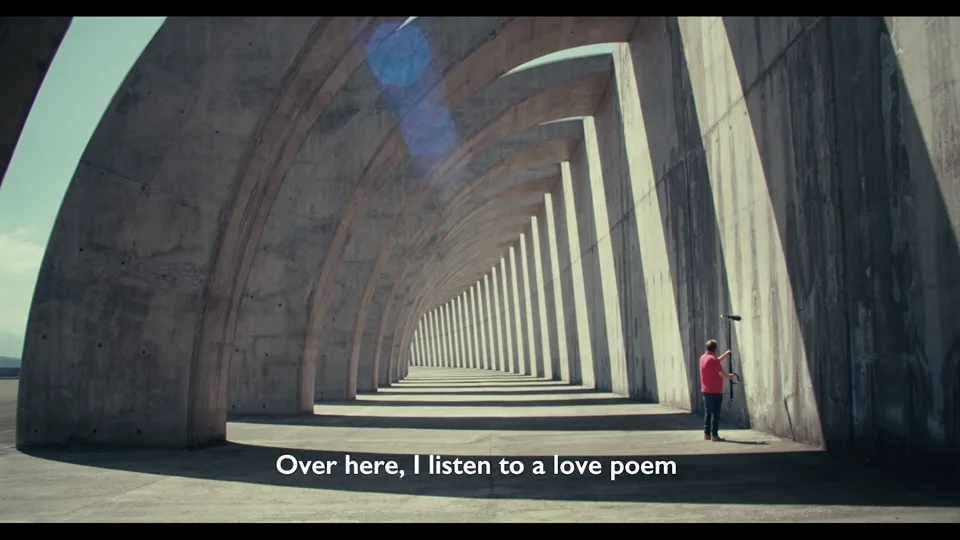
Before the title card at 01:02, we see Ramón dwarfed by a concrete colonnade, boom pole raised high against the wall while he listens for a pirate’s 1761 love poem. Over the next ninety seconds, Kermani and cinematographer Karla Reyes establish a deadpan visual routine: Ramón introduces an unseen companion, and the camera pans over to empty furniture or an unattended beach towel on black sand. Even Ramón laughs at the contradiction around 02:04, joking that he is supposed to be the crazy one. Those pans train the viewer to measure his audio against visible proof—a habit the second half of the film quietly dismantles.
clean up background hiss in field recordingsPutting Ramón in the background changes who the boom mic is for
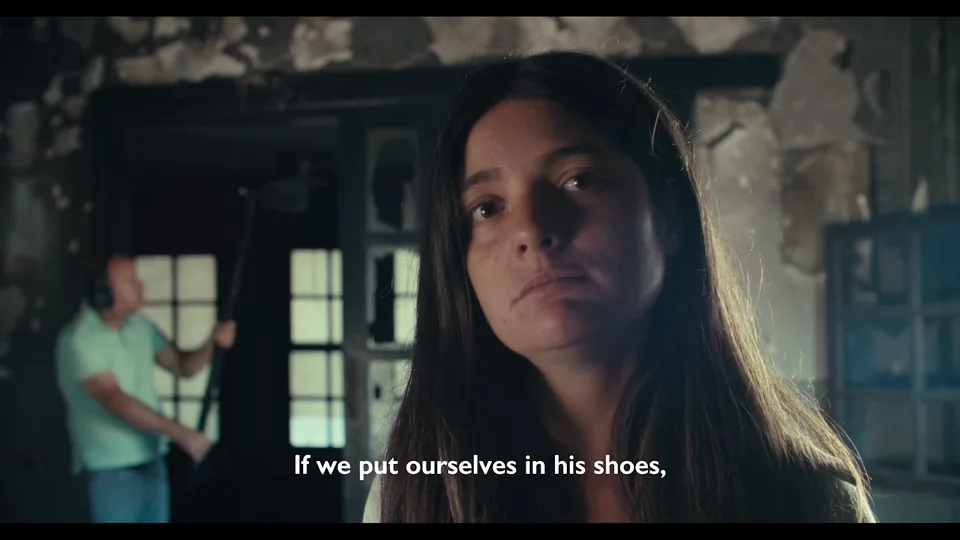
The pivot arrives between 02:37 and 03:54, when the film hands the foreground to other La Palma residents holding Ramón’s portable red radio while he keeps working with his boom pole in the background. In a peeling doorway around 03:26, a young woman asks what anyone has left after losing everything besides memories and feelings; seconds later, at 03:50, Ramón steps out of a doorframe to reveal a room packed waist-high with black volcanic rock. Keeping his microphone visible behind her testimony links his ghost-hunting gear directly to the eruption’s wreckage before Ramón himself breaks down at 05:12 speaking about his late friend Paulino.
Eighteen seconds of lava and an empty room earn the ghosts
Around 05:28, a woman holding an accordion looks across the black lava field that buried her home and says Ramón somehow found the sound of her piano underneath it. Instead of cutting back to Ramón’s headphones, the edit holds from 05:54 to 06:12 on bare hardened lava while solo piano notes play cleanly on the soundtrack. The closing shot inside a scorched hall goes one step further: Ramón says ghosts only want to be listened to, walks out of frame at 06:54, and leaves the locked camera alone with the ash-stained staircase until children’s laughter and cries of “¡Mamá!” echo over the credits at 07:04. One could read those added sounds as directorial embellishment rather than documentary evidence, yet placing them only after Ramón exits makes the edit’s point clear: the film stops asking whether ghosts are on his recorder and lets the audience hear what the islanders are listening for.
Related story cards

Fantasy · 22s
A Song in Bloom
A saved recording brings back a lost voice once, turning private grief into something two neighbors listen to together.
Read the full script →
Horror · 20s
Keep the Applause Going
An empty room responds to a played-back sound cue, letting audio populate a space the camera keeps vacant.
Read the full script →