Sea Star and the Promise Inside a Loan
Chris first accepts help, then offers it. A borrowed pair of goggles gives that change a future.
Scene analysis based on selected image sequences and the official upload’s English captions. Contains scene spoilers; does not assess sound or the film as a whole.
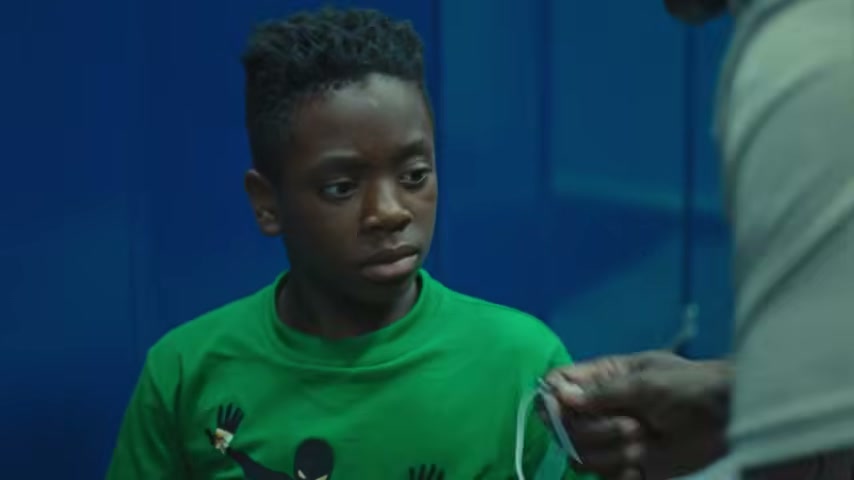
A small sign of progress in Tyler McKenzie Evans’s Sea Star is a pair of goggles changing hands. After a difficult swimming lesson, Chris finds a boy searching his bag. The child has lost his goggles. Chris lends him his own and makes the arrangement temporary: they can meet again. A film about grief finds a modest, tangible way to imagine a future.
That gesture has weight because Chris has already occupied the other side of the exchange. In the pool, he is an adult among children, receiving instructions that everyone around him seems more comfortable putting into practice. Later, he has something useful to offer. His vulnerability and his capacity to care coexist. The film lets a small practical act carry that thought without requiring Chris to explain it.
Learning to accept support
The lesson makes Chris’s size work against the usual visual expectations of authority. In a wide view of the class, his adult body stands out among smaller pupils. Being older has not removed the need to begin. The instructor turns a breath-holding exercise into a contest; a child then dismisses Chris’s success as a matter of age. The social discomfort becomes part of the lesson too.
The floating exercise gives this discomfort a precise physical form. Around 4:35, the instructor supports Chris as he leans back. Several sampled shots place the camera near the waterline, where his head and chest can be seen above the surface while much of his body is obscured. After an interrupted attempt, the lesson continues. The sequence makes dependence visible: learning here involves allowing someone else to hold him.
That is a useful choice for a story whose central difficulty cannot simply be solved by willpower. A triumphant display of swimming technique would make progress easy to measure. This scene asks us to notice the less demonstrative act of accepting assistance. Chris has entered a situation in which control is shared, and the film gives that ordinary arrangement emotional significance.

The promise inside a loan
06:58–07:02 · ChrisYou can have these for now, and I’ll get them back from you the next time I see you.
07:02–07:05 · KelvinOkay. Thank you.
The encounter outside the changing cubicles, around 6:30–7:23, develops the idea further. Chris stops beside the child, retrieves the goggles and helps fit them onto his head. The object we have seen Chris wearing becomes a way to attend to someone else’s apprehension.
The wording matters. In the upload’s English captions, he anticipates the “next time I see you.” The loan supplies a reason for a second meeting. It also gives his reassurance some credibility: he has just been the beginner who needed patience. His new role grows directly from that experience.
There is a possible sentimental shortcut here. A distressed adult finding comfort through an encounter with a child can make the child seem like an instrument of recovery. What keeps this exchange persuasive is its scale. Chris addresses a specific problem with something he can actually give. The scene need not establish that his grief has lifted in order to show that he can still make another person’s day easier.
Progress that can remain private
The later domestic exchange preserves that limited scale. Asked about the gym, Chris answers, “It was okay.” The viewer knows there is more inside that sentence than the conversation reveals. Private progress has not immediately become an articulate account of what he is feeling.
That restraint is where Sea Star offers a useful lesson for character writing. Change becomes legible through a relationship between actions: Chris accepts support, then offers it. The goggles make this connection concrete. We can recognize movement in his life while leaving its pain, and the work still ahead of him, unresolved.

